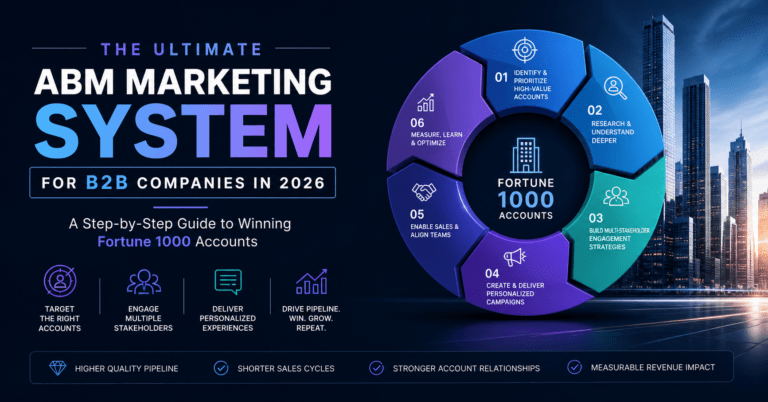
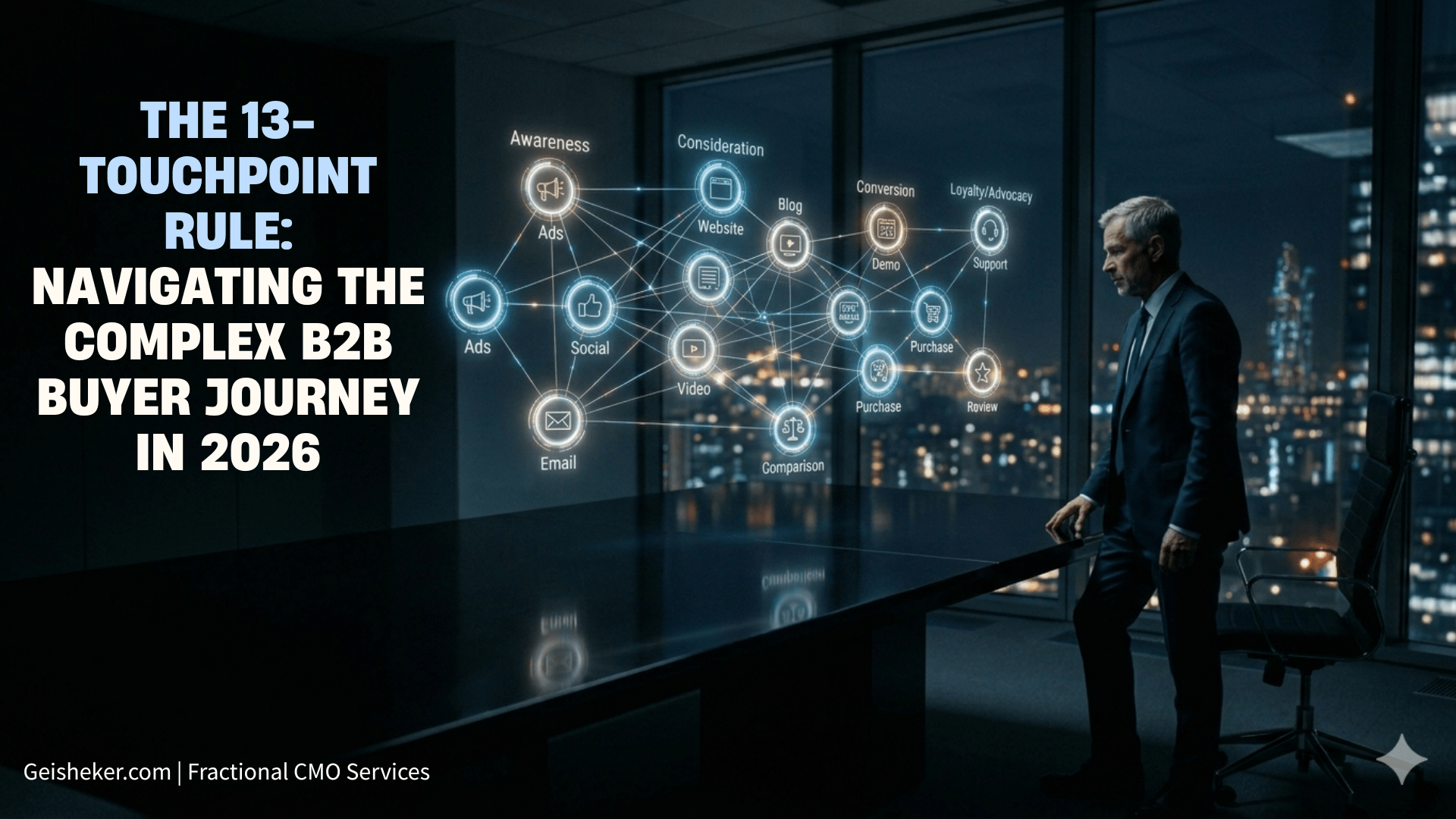
The 13-touchpoint rule is still useful, but it describes the content layer, not the journey. The B2B buyer journey is the full sequence of research, evaluation, and consensus-building a buying group moves through before selecting a vendor, and in 2026 it spans roughly 88 touchpoints across 4 channels involving 10 stakeholders over 272 days. The figure of 13 pieces of content comes from research into enterprise software buyers and still holds up as a model for what buyers read. It is the floor, not the ceiling. What matters is that 94% of buying groups rank their preferred vendor before they ever contact a seller, and they buy from that favorite roughly 77% of the time.
Key Facts at a Glance
- The average B2B buyer consumes 13 pieces of content before a vendor decision, roughly eight vendor-created and five third-party, per FocusVision research reported by MarTech. Important scope note: that study surveyed marketing executives at companies with 500 or more employees and $50 million or more in revenue who had bought a martech solution in the prior year, and it dates to roughly 2019.
- The full journey is far larger than the content layer. The average B2B buying journey now runs 272 days across 88 touchpoints, 4 channels, and 10 stakeholders, per the Dreamdata LinkedIn Ads B2B Benchmarks Report 2026, built on more than 66 million sessions and 3.5 million customer journeys.
- 94% of buying groups rank their shortlist in order of preference before contacting any seller, and they purchase from that preliminary favorite roughly 77% of the time, per 6sense’s 2025 B2B Buyer Experience Report, based on more than 4,000 buyers across North America, EMEA, and APAC.
- 94% of B2B buyers now use AI in their buying process, up from 89% the prior year, and generative AI is now named a more meaningful information source than vendor websites, product experts, or sales, per Forrester’s Buyers’ Journey Survey, 2025.
- The research-to-seller split has moved from 70/30 to 60/40, and average buying cycles shortened from about 11 months in 2024 to about 10 months in 2025, per 6sense’s 2025 research announcement.
- The typical buying group now runs to roughly 11 people, and buyers arrive with eight to nine prior purchase journeys of experience in the category, per 6sense buyer experience research.
- 52% of B2B buyers cite peer recommendations as their most influential information source, per Sopro’s B2B buyer statistics.
This guide was written by Peter Geisheker, Founder and CEO of The Geisheker Group, Inc., a fractional CMO agency serving B2B, B2B SaaS, and investor-backed companies. Peter has spent more than 20 years in direct-response marketing and has managed over $50 million in advertising spend. His view of the touchpoint model has shifted with the data. The old assumption was that a buyer works through a sequence of content and gradually warms up. What he now sees is different: buyers ask an AI assistant who the credible options are, and if you are named in that answer you land on the shortlist before you know a search happened. The buyer who eventually contacts you is not starting an evaluation. They are confirming a decision they already made. The touchpoints still matter, but their job changed. They are no longer persuading a prospect through a funnel. They are the raw material an AI system uses to decide whether to name you at all.
In this article
- What the research actually says about the B2B buyer journey in 2026
- The 13-touchpoint rule as a trust-engineering model
- The 8 vendor-created touchpoints
- The 5 third-party touchpoints
- How to audit your current buyer journey touchpoints
- The real competitive advantage: sequencing, not volume
- What this means for your fractional CMO strategy
- Frequently asked questions
Your buyers finished 60% of the journey before you knew they existed.
A fractional CMO can show you which touchpoints are doing the work and which are dead weight on the page.
What the Research Actually Says About the B2B Buyer Journey in 2026
Here is the most important thing to understand about B2B buying in 2026: by the time a prospect fills out your contact form, the decision is largely made. 6sense’s 2025 B2B Buyer Experience Report found that 94% of buying groups rank their shortlist in order of preference before engaging any seller, and they buy from that preliminary favorite roughly 77% of the time. Second place is a steep climb.
They have not been waiting for your sales team to educate them. They have been reading your blog, studying your case studies, watching your LinkedIn content, comparing you against competitors, and asking AI assistants who the credible vendors are, all before you know they exist.
A FocusVision study found that the average B2B buyer consumes 13 pieces of content before making a vendor decision, typically eight pieces of vendor-created content and five pieces of third-party content. That finding is the origin of the 13-touchpoint rule, and it is worth being precise about what it does and does not say.
What the 13-piece figure actually describes. The FocusVision survey polled marketing executives at companies with at least 500 employees and $50 million in annual revenue who had purchased a martech solution in the previous year. It dates to roughly 2019. It measured deliberate content consumption during an enterprise software purchase. It is a good model of the content layer, and the eight-to-five split between vendor-created and third-party material has held up well.
What it does not describe is the modern journey. The same FocusVision research reported buying processes lasting two to six weeks with three or four internal decision makers. Current data looks nothing like that. The Dreamdata 2026 benchmarks put the average journey at 272 days across 88 touchpoints and 10 stakeholders. 6sense research puts the typical buying group near eleven people and the cycle around ten months.
So treat 13 as the floor, not the ceiling. Thirteen is roughly what a buyer will deliberately read. Eighty-eight is roughly how many times your brand needs to show up across all channels for those thirteen readings to happen at all. Both numbers are useful. Confusing them is how marketing teams end up building thirteen assets and wondering why nothing moved.
Four shifts define the landscape your buyers are operating in.
Buyers are further along than you think. The research-to-seller-engagement split has moved from 70/30 to 60/40, per 6sense’s 2025 findings. Buyers reach out later and arrive more decided. By the time someone requests a demo, they have largely decided whether they like you.
The buying team is much larger. Research from 6sense’s buyer experience studies puts the average buying group near eleven people. Your content is not convincing one person. It is building consensus across a committee of stakeholders with different priorities and different objections.
AI has permanently entered the research process. Forrester’s Buyers’ Journey Survey, 2025 found that 94% of B2B buyers now use AI in their buying process, up five points from 89% the year before, and that twice as many buyers named generative AI or conversational search as a more meaningful information source than any other, outranking vendor websites, product experts, and sales. Your content is not just being read by humans. It is being processed, summarized, and cited by AI systems. Authoritative, specific, data-rich content gets surfaced. Generic content gets ignored.
The shortlist is shorter than ever. Buyers now engage an average of 2.5 vendors, down from 3.2 a few years earlier, per Apollo’s 2026 B2B buyer journey analysis. If you are not on the shortlist before formal evaluation begins, you are almost certainly invisible. This is the same measurement problem described in detail in the case against single-source marketing attribution: the deciding activity happens where your analytics cannot see it.
The 13-Touchpoint Rule: A Framework for B2B Trust Engineering
The FocusVision research that identified 13 pieces of content also noted the critical split: roughly eight pieces of vendor-created content and five pieces of third-party content. This distinction matters enormously because each type serves a different psychological function.
Vendor-created content builds familiarity, demonstrates expertise, and communicates your unique point of view. It answers the question: “Do these people understand my problem and know how to solve it?”
Third-party content provides social proof, reduces perceived risk, and validates your claims through external voices. It answers the question: “Can I trust what this vendor is telling me, and do others like me agree?”
What follows is a practical model rather than a proprietary methodology. It maps thirteen asset types to the trust job each one performs, and the sequence matters more than the count.
The 8 Vendor-Created Touchpoints
Touchpoint 1: The Authoritative Long-Form Blog Post (Awareness Stage)
Trust job: Get found. Establish initial credibility. Make the buyer want to keep reading.
The first touchpoint in nearly every B2B buyer journey is a piece of long-form SEO content. Your prospect is searching Google or querying an AI assistant with a problem-oriented question, and your article needs to show up as the most authoritative answer available.
This is not a 600-word “five tips” post. It is a 3,000 to 5,000 word definitive guide that treats the reader as an intelligent executive, cites real research, presents a unique point of view, and delivers genuine insight they cannot find elsewhere. The trust signal is depth and specificity. A CEO who reads 4,000 words of genuinely useful insight immediately categorizes you as someone who knows what they are talking about. Shallow content produces the exact opposite effect. A well-executed B2B content marketing strategy starts here, with this first authoritative piece that earns the buyer’s attention.
Touchpoint 2: The Problem-Aware Pillar Page (Awareness/Consideration)
Trust job: Show the full scope of the problem. Position your firm as the category authority.
A pillar page is a comprehensive resource that covers a broad topic in enough depth to serve as the definitive reference, while internally linking to more specific articles on subtopics. It is the hub of your content ecosystem and the page you want AI systems to cite when someone asks about your category. Every return visit from a buyer is another touchpoint, another opportunity to build the relationship before they ever contact you.
Touchpoint 3: The Specific Case Study (Consideration Stage)
Trust job: Prove you can actually deliver results. Make the abstract concrete.
This is where most B2B firms fail completely. They write vague case studies that say things like “we helped a mid-size company improve their marketing results significantly.” That is not a case study. It is a press release written by someone afraid to share real numbers.
An effective B2B case study includes the specific problem the client faced in their own language, the measurable baseline before the engagement, the specific strategy deployed and why, the quantified results with real percentages, and a named client quote that validates the outcome. The case study that says “we increased inbound leads by 6X in 14 months for a mid-market B2B technology firm by rebuilding their content strategy and implementing account-based marketing” will outperform every vague alternative by a factor of ten. Specific numbers are believable. Vague claims are not.
Touchpoint 4: The Comparison or “Versus” Content (Consideration Stage)
Trust job: Help buyers who are evaluating alternatives make sense of the landscape.
By the time a B2B buyer reaches the consideration stage, they are actively comparing options. They are searching things like “fractional CMO vs. full-time CMO,” “marketing agency vs. in-house team,” or “content marketing vs. paid acquisition for B2B.” Most companies avoid this type of content because they are afraid to acknowledge that alternatives exist. This is a strategic mistake that costs real pipeline.
When you write an honest, data-driven comparison that acknowledges the legitimate cases for each option and clearly explains when your solution is and is not the right fit, you build extraordinary trust because you are not just selling, and you pre-qualify leads because only the right-fit buyers will proceed after reading an honest assessment.
Ready to see what a complete content strategy looks like for your B2B company? Schedule a free 30-minute strategy call with Peter Geisheker and get a direct assessment of where your buyer journey touchpoints are strong and where they are leaking revenue.
Touchpoint 5: The Pricing or Investment Page (Consideration/Decision)
Trust job: Remove the biggest objection. Qualify serious buyers before the first sales conversation.
Most B2B service firms hide their pricing entirely, forcing prospects to “schedule a call to learn more.” This creates friction, destroys trust, and pre-selects the wrong behavior. Publishing clear pricing information, even just a “starting at” number, qualifies leads before they book a call, builds trust through transparency, and answers the question every serious buyer is already Googling whether you want them to or not. Hiding pricing signals fear. Publishing it signals confidence in your value. Companies serious about generating B2B leads consistently treat the pricing page as a conversion asset, not a liability.
Touchpoint 6: The Educational Video or Webinar (Consideration Stage)
Trust job: Build personal connection. Let buyers experience your thinking before they commit to a call.
Written content builds intellectual trust. Video builds personal trust. These are meaningfully different things, and a complete B2B buyer journey strategy requires both. A CEO evaluating a fractional CMO is not just buying a service. They are choosing a person who will have significant influence over their company’s revenue strategy. A 15-minute LinkedIn video where you walk through a real problem or analyze a B2B marketing situation does more trust-building work than three written blog posts. You cannot fake depth of knowledge on video the way you can in edited written content.
Touchpoint 7: The ROI Calculator or Assessment Tool (Decision Stage)
Trust job: Help buyers build the internal business case for working with you.
By the time a buyer reaches the decision stage, they need to justify the investment internally, and with a buying group near eleven people that justification has to survive several rooms you will never be in. An interactive ROI calculator that lets buyers input their current lead volume, conversion rates, average deal size, and marketing spend, then shows them what a 6X inbound lead increase would mean for their annual revenue, does the internal business case work for them. It is one of the highest-converting assets you can create for a B2B service firm, and almost no one builds it.
Touchpoint 8: The Personalized Direct Outreach (Decision Stage)
Trust job: Personalize the relationship. Convert warm research signals into a scheduled conversation.
The eighth vendor-created touchpoint is not a content asset. It is a direct, personalized outreach sequence triggered by buyer behavior signals. When someone downloads your ROI calculator, reads four blog posts in a single session, or visits your pricing page twice in a week, they are sending clear intent signals. A personalized email or LinkedIn message that references what they have been researching, and offers a specific low-commitment next step, converts warm intent signals into booked meetings at rates that generic outreach cannot match. This is the execution layer of a well-built B2B demand generation system.
Eight assets you control. Five you do not.
Most B2B companies build some of the first eight and none of the last five. That gap is where deals quietly go to competitors.


Get a free written growth plan from two senior CMOs
30 minutes with both of us. No hard sell. Written plan in 3 business days.
The 5 Third-Party Touchpoints
Touchpoint 9: Google Reviews and Third-Party Rating Platforms (All Stages)
Trust job: Validate your claims through unfiltered external voices that have nothing to sell.
When a B2B buyer is seriously researching you, one of the first things they do is search “[Your Company Name] reviews.” If they find nothing, or find negative reviews with no response, the trust you built through eight pieces of your own content can evaporate instantly. Proactively collecting and managing your Google Business Profile reviews, G2 reviews, and Clutch.co ratings is a load-bearing element of your B2B buyer journey. Social proof from people with nothing to sell is the most trusted form of validation in B2B purchasing.
Touchpoint 10: Peer Recommendations and Referrals (All Stages)
Trust job: Transfer trust from a known relationship to an unknown vendor.
According to research from Sopro, 52% of B2B buyers cite peer recommendations as their most influential information source. When someone a buyer respects says, “You should talk to Peter at The Geisheker Group, they rebuilt our content engine and we tripled our pipeline in 18 months,” that single recommendation carries more weight than everything else on this list combined. Building a systematic referral program is one of the highest-ROI activities in B2B marketing, and the one most firms consistently neglect.
Want to know if your current content strategy is capturing buyers at every stage of their research journey? Book a free strategy call with Peter Geisheker and get a clear picture of exactly where your B2B buyer journey has gaps.
Touchpoint 11: Industry Publication Features and Press Mentions (Awareness/Consideration)
Trust job: Signal category authority through third-party editorial endorsement.
Being featured in Inc. Magazine, Entrepreneur, Forbes, or a respected industry publication creates a category of trust that you simply cannot manufacture through your own content. When a buyer Googles your name and finds you have been quoted in major business publications, it validates your authority in a way a self-published blog post never can, because an independent editor chose to include you based on their own assessment of your expertise. This kind of earned media is one of the most powerful tools for B2B brand positioning that exists. A consistent HARO strategy, combined with targeted pitching of expert commentary to relevant trade publications, can generate steady press coverage that shows up every time a buyer researches you.
Touchpoint 12: LinkedIn Content and Professional Community Visibility (All Stages)
Trust job: Build ambient authority through consistent, visible thought leadership where buyers spend their professional time.
LinkedIn is where B2B buyers spend a meaningful portion of their professional research time. A consistent LinkedIn presence, meaning original posts, long-form articles, commentary on industry developments, and participation in relevant professional conversations, keeps you top of mind with buyers who may be six, twelve, or eighteen months away from being ready to engage.
One caution about how you measure this touchpoint, because it is the one most likely to be killed by a dashboard. Peter Geisheker has over 7,000 followers on LinkedIn, and the platform shows his posts to roughly 100 of them. A reach rate under 2% looks, on any analytics view, like a channel that does not work. It is not a content problem and it is not evidence the channel is dead. In-feed reach and actual influence are different things. The posts do their job when a CEO looks him up after a referral or a podcast mention, and that job never appears in an impressions column. Judge this touchpoint by whether your profile converts the people who arrive already interested, not by how many people the algorithm chose to show you to.
Touchpoint 13: AI-Generated Research Summaries (Awareness/Consideration)
Trust job: Be the recommended answer when buyers ask AI systems about your category.
This is the newest and fastest-growing touchpoint in the B2B buyer journey, and the one most firms are completely unprepared for. When a buyer asks ChatGPT, Gemini, Perplexity, or Claude “what should I look for in a fractional CMO,” the AI system synthesizes an answer from the content it has indexed. If your content is authoritative, specific, well-structured, and frequently cited by other sources, you have a significantly higher probability of being named in those answers.
Forrester’s Buyers’ Journey Survey, 2025 found that 94% of B2B buyers now use AI in their buying process, and that generative AI and conversational search have overtaken vendor websites, product experts, and sales as the information source buyers name as most meaningful. That means the overwhelming majority of your potential buyers may be forming their initial opinions about your category through AI-generated answers before they ever visit your website. When an AI system names you without being prompted to, buyers perceive that as close to unbiased endorsement.
How to Audit Your Current B2B Buyer Journey Touchpoints
Most B2B companies have some of these 13 touchpoints covered, but very few have all of them working together as a cohesive system. For each of the 13 touchpoints, ask four questions:
- Do we have this touchpoint in place at all?
- Is it doing its specific trust-building job effectively, or is it just checking a box?
- Is it connected to the next touchpoint in the sequence, or does the buyer hit a dead end?
- When did we last update or optimize it to reflect current buyer behavior?
The gaps you find are not content problems. They are revenue problems. Every touchpoint that is missing or underperforming represents a buyer who encountered friction, lost confidence, and moved on to a competitor who had the right content in the right place at the right moment.
There is a fifth question worth adding, and it is the one that separates a content program from a revenue program: can this touchpoint fail fast enough to teach you something?
Peter Geisheker’s view on this is blunt. A brand campaign with no measurable response cannot be judged and cannot be corrected. You wait six months, revenue is flat or up, and nobody can tell you which half of the work mattered. A touchpoint built to produce a response can be judged in a week. That is the honest limitation of the branding-only argument. It is not that brand does not work; it is that it cannot fail fast, and anything that cannot fail fast cannot compound. The counterweight is that direct-response-only thinking will optimize you into a corner where the offer converts and nobody has heard of you. Build touchpoints that do both jobs, and instrument the ones that can be instrumented.
The Real Competitive Advantage: Sequencing, Not Volume
The most common mistake B2B companies make with content is treating it as a publishing exercise rather than a trust-engineering exercise. Content volume without intentional sequencing is noise. A buyer who reads your awareness-stage blog post and then cannot find a case study, a pricing page, or any social proof has hit a dead end. They will leave and find a competitor who has those things in place.
The other mistake is quitting before the compounding starts. Peter Geisheker worked with a B2B SaaS client that went from roughly $250,000 to $2 million in annual revenue over about three years. The lever was not a clever campaign. It was more than a hundred SEO articles that nobody else in the category had the patience to keep writing. The honest caveat is that this was one client, in one category, in a period when SEO was still cheap, and search behavior has changed since. The transferable part is not the channel. It is the pattern: a durable content asset built past the point where most competitors lose interest, in a market where the buying group is eleven people and the journey runs most of a year. Thirteen touchpoints published once is a campaign. Thirteen touchpoints maintained for three years is a moat.
The companies that consistently win in the B2B buyer journey are not the ones with the most content. They are the ones who have engineered every stage of the journey, from the first Google search to the peer recommendation to the AI-generated answer, to systematically build the trust that converts research into revenue. That is the fundamental difference between a content calendar and a revenue system. One measures output. The other measures outcomes. Strong sales and marketing alignment is what ensures each touchpoint hands off cleanly to the next.
What This Means for Your Fractional CMO Strategy
A fractional CMO who understands the modern B2B buyer journey will not build you a content calendar. They will build you a trust-engineering system, one that places the right content in the right channels at the right stage of the buyer journey, connects each touchpoint to the next, and continuously optimizes based on which touchpoints are driving qualified pipeline and which are losing buyers to competitors. This is what a real B2B marketing strategy framework looks like in practice. The same discipline applies at portfolio scale, which is why fractional CMOs working with PE portfolio companies tend to start with a touchpoint audit before touching budget.
If your current marketing is not delivering the inbound leads your business needs to grow predictably, the problem is almost certainly a gap in your buyer journey: a missing touchpoint, a weak piece of content at a critical stage, or a disconnect between what you are publishing and what your buyers are actually searching for.
If you want to understand exactly where your B2B buyer journey is strong and where it is losing buyers to competitors, schedule a free 30-minute strategy call with Peter Geisheker. We will map your current touchpoints, identify the gaps, and give you a prioritized action plan with specific recommendations. No pitch deck, no sales pressure.
Frequently Asked Questions About the B2B Buyer Journey
How many touchpoints does a B2B buyer have before making a purchase decision?
It depends on what you are counting. FocusVision research found the average B2B buyer deliberately consumes 13 pieces of content before a vendor decision, typically 8 vendor-created and 5 third-party. That describes the content layer. The full journey is much larger: Dreamdata’s 2026 benchmark analysis puts the average B2B buying journey at 88 touchpoints across 4 channels and 10 stakeholders over 272 days, counting every brand interaction including advertising exposures and sales interactions. Use 13 to plan your content. Use 88 to set expectations about frequency and patience.
Is the 13-touchpoint rule still accurate in 2026?
Partly. The underlying FocusVision study dates to roughly 2019 and surveyed marketing executives at enterprise companies buying martech, so it is neither current nor universal. The 8-to-5 split between vendor-created and third-party content has held up well and remains a useful planning model. What has not held up is the surrounding context from that same study, which described two-to-six-week buying processes with three or four decision makers. Current research puts buying groups near eleven people and cycles around ten months. Treat 13 as a content planning heuristic, not as a description of the journey.
What percentage of the B2B buyer journey is complete before a buyer contacts a vendor?
Roughly 60%, and the decisive part is done well before that. 6sense’s 2025 Buyer Experience Report found the research-to-seller-engagement split has moved from 70/30 to 60/40, and that 94% of buying groups rank their shortlist in order of preference before contacting any seller. They purchase from that preliminary favorite roughly 77% of the time. The practical implication is that the evaluation you get invited to is often a confirmation exercise, not a competition.
What types of content are most effective at each stage of the B2B buyer journey?
At the awareness stage, long-form SEO blog posts, pillar pages, and LinkedIn thought leadership perform best. At the consideration stage, case studies, comparison content, pricing pages, and educational videos carry the most weight. At the decision stage, ROI calculators, peer reviews, personalized outreach, and reference calls are decisive. Third-party content including press features, G2 reviews, peer referrals, and AI-generated summaries supports trust-building at every stage.
How has AI changed the B2B buyer journey in 2026?
Forrester’s Buyers’ Journey Survey, 2025 found that 94% of B2B buyers now use AI in their buying process, up from 89% the prior year, and that generative AI and conversational search have overtaken vendor websites, product experts, and sales as the information source buyers name as most meaningful. This created an entirely new category of touchpoint, the AI-generated research summary, where buyers ask tools like ChatGPT, Perplexity, or Gemini about vendor categories, best practices, and solution comparisons. Companies with authoritative, well-structured, data-rich content are increasingly cited in those answers. Companies without it are simply not named.
How do you know which touchpoints are actually working?
Mostly you cannot, at least not through standard analytics, and pretending otherwise leads to bad budget decisions. AI citations, peer referrals, and private-channel sharing generate no referrer data, so they arrive as direct traffic. The practical answer is self-reported attribution: a required “How did you first hear about us?” field on every high-intent form. It is the only mechanism that surfaces the touchpoints your software cannot see. This is covered in depth in the discussion of whether marketing attribution is dead.
What is the single most overlooked touchpoint in B2B marketing?
Peer referrals and direct recommendations. Despite research from Sopro showing that 52% of B2B buyers cite peer recommendations as their most influential information source, most B2B companies have no systematic approach to generating referrals from satisfied clients. It is the highest-trust, lowest-cost touchpoint on the list and the one most consistently left to chance.
How long is the average B2B sales cycle in 2026?
6sense’s 2025 research found average buying cycles shortened from about 11 months in 2024 to about 10 months in 2025, driven largely by economic pressure. Nearly half of buyers said economic conditions shortened their cycles and 62% engaged sellers earlier as a result. Mid-market B2B companies with smaller deal sizes typically see shorter cycles when their buyer journey is well-engineered and content-rich at every stage.
About Peter Geisheker
Peter Geisheker is the Founder and CEO of The Geisheker Group, Inc., a fractional CMO and B2B marketing advisory serving CEOs and investor-backed companies. He specializes in scalable, capital-efficient revenue systems across B2B SaaS, B2B services, and performance-driven environments, with AI embedded across all engagements. His work includes programs delivering 6X inbound lead growth, 100% year-over-year SaaS revenue growth for three consecutive years, and a 77% reduction in paid acquisition spend while growing revenue. Connect with Peter on LinkedIn.
References and Sources
- MarTech. “B2B buyers consume an average of 13 content pieces before deciding on a vendor.” Coverage of the FocusVision content consumption study. https://martech.org/b2b-buyers-consume-an-average-of-13-content-pieces-before-deciding-on-a-vendor/
- MarketingCharts. “B2B Buyers Rely on Vendor Websites for Content.” Additional coverage of the FocusVision study. https://www.marketingcharts.com/industries/business-to-business-112579
- Dreamdata. “Announcing the LinkedIn Ads 2026 Benchmarks Report.” March 2026. https://dreamdata.io/blog/announcing-linkedin-ads-benchmarks-report-2026
- 6sense. “The B2B Buyer Experience Report for 2025.” https://6sense.com/science-of-b2b/buyer-experience-report-2025/
- 6sense. “The Timeline for Influencing B2B Buyers Is Shrinking.” November 12, 2025. https://6sense.com/newsroom/the-timeline-for-influencing-b2b-buyers-is-shrinking-insights-from-6senses-2025-buyer-experience-report/
- 6sense. “The Critical Period for B2B Buying and the 70% Solution.” October 2024. https://6sense.com/science-of-b2b/the-critical-period-for-b2b-buying/
- 6sense. “Getting to Yes: Why Vendors Win and How Buying Groups Agree.” November 2025. https://6sense.com/science-of-b2b/getting-to-yes-why-vendors-win-and-how-buying-groups-agree/
- CustomerThink. “Research Round-Up: A Detailed Look at Real-World B2B Buying.” Analysis of the 6sense B2B Buyer Experience Study. https://customerthink.com/research-round-up-a-detailed-look-at-real-world-b2b-buying/
- Forrester. “B2B Buyers Make Zero-Click Buying Number One.” January 28, 2026, citing Forrester’s Buyers’ Journey Survey, 2025. https://www.forrester.com/blogs/b2b_buyers_make_zero_click_buying_number_one/
- Forrester. “B2B Buyer Adoption Of Generative AI.” November 20, 2024, based on Forrester’s Buyers’ Journey Survey, 2024. https://www.forrester.com/report/b2b-buyer-adoption-of-generative-ai/RES181769
- Forrester. “Why ‘Performance Marketing’ Falls Short,” citing Forrester’s Buyers’ Journey Survey, 2024. https://www.forrester.com/blogs/why-performance-marketing-falls-short/
- Forrester. “Building Preference Is The Key To Winning B2B Buyers,” citing Forrester’s Buyers’ Journey Survey, 2025. https://www.forrester.com/blogs/building-preference-is-the-key-to-winning-b2b-buyers/
- Apollo. “What’s Changed in the B2B Buyer Journey in 2026?” https://www.apollo.io/insights/b2b-buyer-journey
- Sopro. “68 B2B Buyer Statistics and Insights.” https://sopro.io/resources/blog/b2b-buyer-statistics-and-insights/
- MarketingProfs. “Why It Should No Longer Take 13 Pieces of Content to Convert a Buyer.” Context on the limits of the 13-piece model. https://www.marketingprofs.com/articles/2021/46283/why-it-should-no-longer-take-13-pieces-of-content-to-convert-a-buyer
Free Written Growth Plan
Want this thinking applied to your business?
Book a free 30-minute working session with two senior CMOs. You leave with a written growth plan you can use whether or not you hire us.
No hard sell on the call. Your plan arrives within 3 business days. See a sample plan