
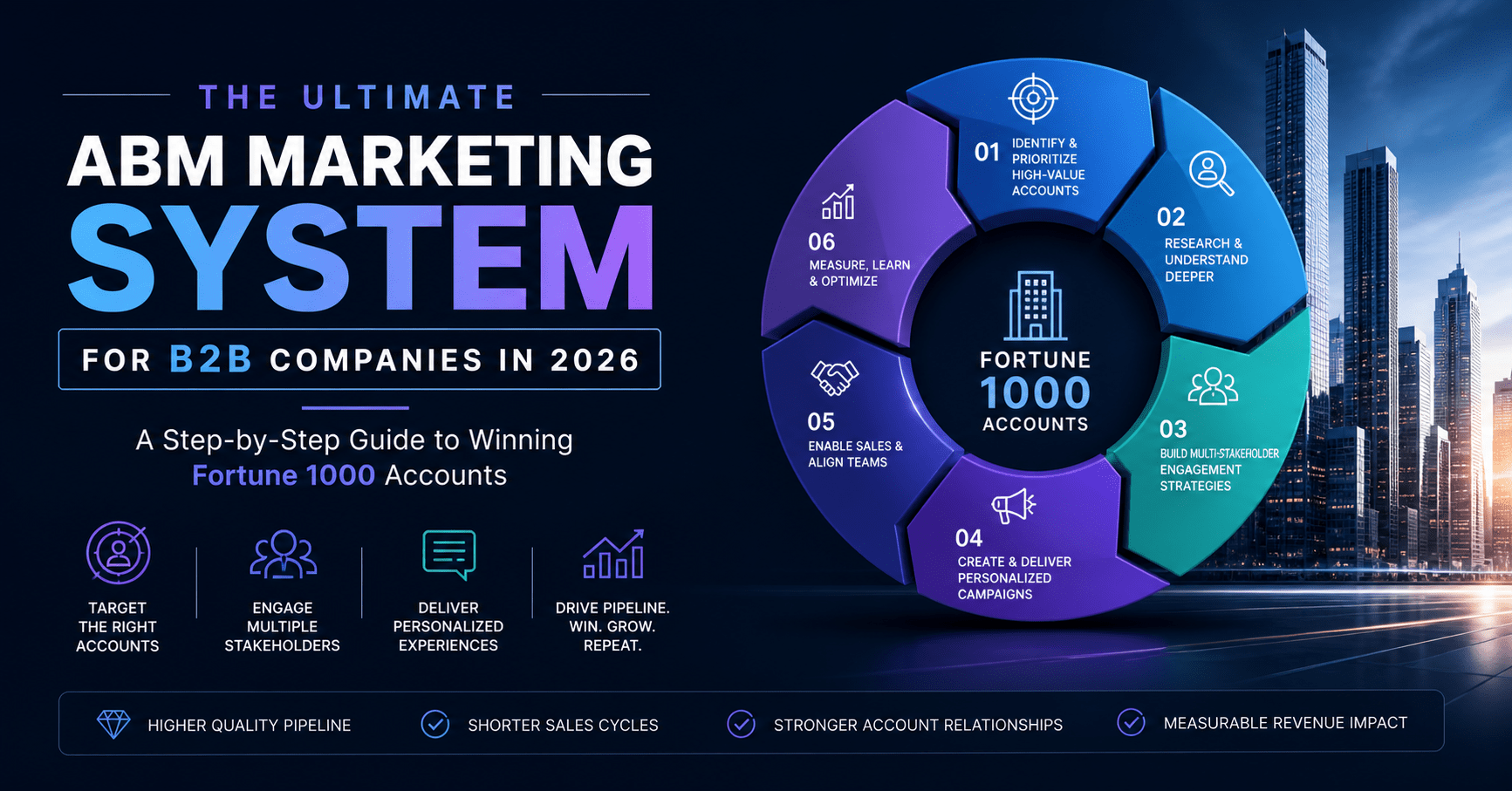
Build an ABM system in seven steps, in order: tier a short list of target accounts, map each buying committee, tie intent signals to specific plays, coordinate channels by role, use AI personalization only where deal size justifies it, put sales and marketing on one written agreement, and measure pipeline by account instead of counting leads.
Key facts
- The typical B2B buying decision now includes 13 internal stakeholders and nine external influencers, according to Forrester’s State of Business Buying 2026.
- Procurement professionals are decision-makers in 53% of business buying cycles and engage from the start (Forrester).
- Marketing and sales teams typically collaborate on only three out of 15 commercial activities, per a Gartner survey of 412 senior marketing and sales leaders.
- Only about 5% of B2B buyers are in market at any given time, based on research by Professor John Dawes of the Ehrenberg-Bass Institute.
- In my own career I have produced 6X inbound lead growth, 100% year-over-year SaaS revenue growth three years running, and a 77% reduction in paid acquisition costs.
If your B2B marketing is still judged on MQL volume, you are keeping the wrong score. The companies winning large enterprise contracts have rebuilt their go-to-market around named accounts, mapped buying committees, and pipeline numbers their CFO trusts.
This guide lays out that system step by step. It is built to be installed in a first 90-to-120-day push, then refined every quarter, and draws on 20+ years of B2B and SaaS marketing, including managing $50M+ in annual ad spend.
What an ABM system is, and why most programs stall
An ABM (account-based marketing) system concentrates marketing and sales effort on a short list of high-value accounts, reaches every member of each account’s buying committee with coordinated, personalized touches, and measures success by account progress and pipeline, not lead counts. It fits companies with large contract values and multi-stakeholder buying decisions.
Most ABM programs stall for three predictable reasons. None of them require more budget to fix.
- Tier collapse. Marketing buys an ABM platform, names 500 accounts “tier 1,” and then treats all 500 the same way. That is a label, not a program. Concentration beats coverage. Keep true tier 1 small, typically 5 to 25 accounts per dedicated team, and treat the rest at lighter tiers.
- Platform before program. The tooling arrives before the operating model. Sales has not committed to the account list, nobody has mapped buying committees, and there is no written agreement on what counts as an engaged account.
- Single-threading. Outreach goes to one persona at each account, while the decision is made by a group of 13 or more people. When your one contact leaves or goes quiet, the deal dies.
All three can be diagnosed in about 30 days and fixed within a quarter.


Try two senior CMOs before you hire them
30 minutes with both of us. No hard sell. Written plan in 3 business days.
The seven steps, in dependency order
Each step produces what the next one needs. Skipping a step is the most common mistake I see. Teams that add AI personalization (step 5) before mapping the buying committee (step 2) personalize to the wrong people. Teams that build attribution (step 7) before sales and marketing agree on definitions (step 6) end up measuring activity instead of outcomes.
- Account selection and tiering: a short, defensible tier-1 list with a revenue reason for each account.
- Buying committee mapping: verified contacts and roles for every stakeholder at each tier-1 account.
- Intent signals tied to plays: first-party and third-party signals, each routed to a documented action.
- Channel orchestration by role: coordinated touches sequenced by persona and buying stage.
- Tiered AI personalization: deep personalization at tier 1, lighter treatment below.
- A written sales and marketing agreement: shared list, service-level agreement (SLA), weekly cadence, one dashboard.
- Account-level measurement: pipeline and win-rate reporting that compounds quarter over quarter.
Step 1: Select and tier your target accounts
The tier-1 list is the center of gravity for the whole program. Get it right and every later investment compounds. Get it wrong and every dollar lands in the wrong place.
Build the list from three inputs:
- An ideal customer profile that goes beyond firmographics to include technology stack and strategic fit.
- Trigger signals such as funding events, executive hires, and technology migrations.
- Sales input on competitive position and existing relationships.
Refresh the tier-1 list every quarter. Accounts whose signals have gone cold or whose strategy has shifted move down to tier 2. Newly in-market accounts move up.
| Tier | Typical number of accounts | Personalization depth | Main tactics |
|---|---|---|---|
| Tier 1 (1:1 strategic) | 5 to 25 | Built for one account | Account-specific pages and content, executive plays, custom ROI work |
| Tier 2 (1:few clusters) | 20 to 100 | Built for a group of similar accounts | Industry or use-case campaigns, semi-custom assets |
| Tier 3 (1:many programmatic) | 200 to 1,000+ | Automated, keyed to firmographics | Dynamic ads, automated nurture, IP-based web personalization |
Set the budget for each tier from your own contract values and win rates, not from someone else’s benchmark. The question is simple: how much can you spend per account and still make the deal profitable at your close rate?
Step 2: Map the buying committee at each account
Buying committee mapping means identifying every stakeholder in a deal, documenting their role, and tracking how engaged each one is. Forrester reports the typical decision now involves 13 internal stakeholders and nine external influencers, with the number rising for more complex purchases. Procurement is a decision-maker in 53% of buying cycles and is involved from the start, not just at the end.
At minimum, map these roles:
- Economic buyer (budget authority)
- Technical evaluator (integration and security)
- End users (day-to-day usability)
- Champion (your internal advocate)
- Executive sponsor (organizational cover)
- Legal and procurement (contract and compliance)
Mapping draws on three sources: discovery questions to your champion, org-chart research, and contact enrichment tools for verified emails and direct dials. The output is a per-account committee map with a simple status for each person (engaged, aware, or unreached), updated weekly.
Step 3: Tie intent signals to specific plays
Intent data separates accounts that are ready to buy from accounts that merely fit your profile. Research by Professor John Dawes of the Ehrenberg-Bass Institute found that only 5% of B2B buyers are in market at any given time. On a 500-account list, that means only a small fraction is actively buying in a given month. Programs that find those accounts and act on them outperform programs that treat the whole list the same.
A practical signal stack has three layers:
- First-party signals: visits to pricing or comparison pages, depth of content consumption, product trial activity.
- Third-party intent: research activity from intent data providers and review sites.
- Trigger events: funding rounds, executive hires, technology adoption, layoffs, mergers and acquisitions.
The operating rule: every signal type gets a documented play. A visit to your product page on a review site starts an SDR sequence within four hours. A competitor comparison signal triggers a competitive-displacement page. A new marketing leader at a target account triggers an executive outreach play. Without that mapping, intent data is just a dashboard. Choosing the platform that surfaces these signals is its own decision, which I cover in the guide to the most effective ABM platforms for B2B enterprise pipeline generation.
Step 4: Orchestrate channels by role and stage
No single channel wins enterprise ABM. The goal is for each target account to see one coherent message across paid, owned, and earned channels for months before the deal enters formal evaluation. Preference forms early. If you show up only when the RFP lands, you are usually there to be the comparison quote.
The channels that anchor most enterprise ABM programs:
- LinkedIn account targeting to serve ads to verified decision-makers inside named accounts.
- Account-targeted programmatic display and CTV to reach the committee outside work media. I cover this channel in detail in the playbook for account-targeted programmatic display and CTV.
- Personalized direct mail and executive gifting for physical differentiation in an all-digital inbox. See whether B2B companies should spend more on direct mail.
- Account-specific pages for tier-1 accounts, with their name, their stated challenges, and a tailored ROI case.
- Executive thought leadership from your own leaders on LinkedIn.
- Multi-touch SDR sequences coordinated with the rest of the play, not running in parallel: 6 to 9 touches across email, phone, and LinkedIn over two to three weeks.
- Small, in-person executive events such as industry dinners or roundtables that put the economic buyer in the same room as your head of revenue.
Every channel still needs a response mechanism and a way to measure it. ABM is not an excuse for unmeasured brand spending.
Step 5: Apply AI personalization by tier
AI personalization is the most powerful new capability in ABM and the most commonly misused one. My rule: deploy true one-to-one dynamic copy only at tier 1. Programs that roll it out across every tier spend their best capability on accounts that do not justify it and dilute the effect on the accounts that do.
- Tier 1: AI drafts account-specific pages, briefs, and outreach from your account research. A human edits every piece before it goes out.
- Tier 2: AI builds content at the cluster level (industry, use case, persona).
- Tier 3: AI handles ad creative variations and on-site personalization keyed to firmographics.
The practical win is speed. AI makes one-to-one pages and briefs fast enough to produce that a small team can run real tier-1 ABM, which used to require a much larger staff.
Step 6: Put sales and marketing on one written agreement
Alignment is where ABM programs succeed or collapse. Gartner found that marketing and sales collaborate on only three of 15 commercial activities, and only 17% of the leaders surveyed collaborate on buyer journey mapping. The same survey found commercial teams that share buyer journey insights are 1.6x more likely to exceed revenue growth expectations.
The agreement needs four parts:
- A shared target account list that both teams commit to, not one marketing assigns.
- A written SLA defining what an engaged account is, when an account is handed off, and how fast sales responds.
- A weekly 30-minute meeting where sales and marketing review account engagement, new signals, and next actions together.
- One shared dashboard showing influenced pipeline and revenue, never separate MQL and SQL counts.
In practice this replaces the old MQL handoff. Marketing identifies the engaged buying group at a target account, sales receives the whole mapped committee with engagement status, and both teams work the account together until it closes.
Step 7: Measure at the account level
First-touch and last-touch attribution undercount a buying journey that runs for months across many people. Measure five things instead:
- Coverage: the share of each mapped committee with verified contact data and at least one engaged contact.
- Engagement: accounts moving from cold to aware to engaged to opportunity, scored at the account level.
- Pipeline influenced: the dollar value of opportunities at target accounts where ABM activity came before opportunity creation.
- Win rate by tier: closed-won rate on engaged accounts, split by tier 1, 2, and 3.
- Deal size and net revenue retention: average contract value and retention for ABM accounts versus non-ABM accounts.
The report your CFO will trust is a quarterly account-progression dashboard. It shows each tier-1 and tier-2 account with its current stage, last engagement date, committee mapping status, and influenced pipeline. Clicks, impressions, and MQL counts are operational details, not the headline. For how to present those numbers to a buyer’s finance team, see how to show ROI when selling B2B products and services.
How to adapt the system for Fortune 1000 accounts
Large enterprise accounts follow the same seven steps with a few adjustments.
- Lead with the committee, not the buyer. With 22 or more people involved in a typical decision, your program has to build preference across the group well before procurement opens.
- Plan around budget cycles and strategic initiatives. An account that ignores you in Q3 may come alive in Q1 when budget opens up. Digital transformation, cost reduction, and post-merger integration programs create buying windows you should position for in advance.
- Be findable in AI answers. Enterprise buyers now do early research in ChatGPT, Claude, Perplexity, and Gemini before contacting a vendor. If your company is not cited in those answers, you are missing from the earliest part of the journey.
- Engage analysts and consultants. External influencers are part of the buying network, so analyst relations belong inside the ABM plan, not in a separate silo.
- Have a structured trial ready. Forrester reports that more than 60% of business buyers use a trial to evaluate solutions, and 78% of buyers making purchases of $10 million or more run a trial first. Prepare scoped, time-boxed proofs of value as standard offerings, not custom one-offs.
- Equip your champion to sell internally. Most of the buying conversation happens when you are not in the room. Give your champion forwardable executive briefs, ROI calculators, security one-pagers, and short demo videos that travel through internal email and chat.
When ABM is the wrong strategy
ABM is not right for every company. Broad demand generation produces better economics in these situations:
- Small contracts. When average contract value is under roughly $25,000, the per-account cost of real ABM is hard to recover, even if lifetime value is decent.
- Huge, fragmented markets. When the addressable market runs past several thousand accounts with no clear concentration, programmatic demand generation is usually cheaper than account selection.
- One- or two-person decisions. Small businesses buying point solutions on short cycles do not have a buying committee, so multi-threading adds cost without adding value.
- Misaligned revenue teams. If sales and marketing do not agree on targets and definitions, ABM becomes a label on the old program. Fix alignment first, then build ABM on top.
Frequently asked questions
How long does it take to build an ABM system?
Plan a first push of 90 to 120 days to stand up all seven steps, then refine every quarter. Early signals such as engagement gains, meetings booked, and new opportunities typically show up in the first three to six months. Pipeline impact follows over the next two quarters, and closed revenue on enterprise sales cycles can take a year or more.
What is the difference between 1:1, 1:few, and 1:many ABM?
1:1 ABM treats each of a small number of strategic accounts as a market of one, with content built for that account. 1:few ABM groups accounts by industry or use case and runs semi-custom campaigns for each cluster. 1:many ABM uses automated personalization across hundreds of accounts. The three tiers work together, and accounts move up as they show engagement and intent.
Which step do most companies get wrong?
Step 6, the sales and marketing agreement. Teams tend to underestimate alignment and overestimate tooling. A strong operating model with modest tools beats expensive tools with no operating model, and Gartner’s finding that the two functions collaborate on only three of 15 commercial activities shows how common the gap is.
Do I need an ABM platform before I start?
No. You can run steps 1, 2, 6, and 7 with your CRM, a verified contact data provider, and LinkedIn Ads. Add a platform once you know which signals and plays you need it to support. The platform guide linked in step 3 covers how to choose one.
How many target accounts should be in tier 1?
Fewer than most teams want. A dedicated team can usually give real one-to-one treatment to somewhere between 5 and 25 accounts. If your tier-1 list runs into the hundreds, you have a tier-3 program with a tier-1 label.
What should I report to the board in the first six months?
Report leading indicators: committee coverage, account engagement progression, and how many target accounts have multiple engaged contacts. Pipeline dollars lag on long sales cycles, so judging the program on closed revenue in month three will kill a program that is working.
Installing this in your company
Deciding which steps you need is the easy part. The hard part is installation: getting sales to commit to the account list, building measurement that turns platform data into board-grade reporting, and shifting the whole team from lead volume to account progress. That is where most ABM programs stall.
If you already have an experienced marketing leader who has installed ABM before, you may not need outside help. If you do not, that gap is the kind of work a fractional CMO handles. If you are new to the model, here is what a fractional CMO is. Our Fractional CMO Leadership starts at $10,000 per month with a 90-day minimum sprint, and you can see how fractional CMOs charge for context.
The fastest way to find out whether ABM fits your company is a free 30-minute growth plan session with Michael Pecora and me on Google Meet. You get a written growth plan within 3 business days, with no hard sell. We take 10 companies a month. Book your growth plan session.
Free Written Growth Plan
Wondering if a fractional CMO is right for you?
Try us before you hire us. Book a free 30-minute working session with both of us and get a written growth plan you can use whether or not you hire us.
Get My Free Growth Plan →No hard sell on the call. Your plan arrives within 3 business days. See a sample plan